
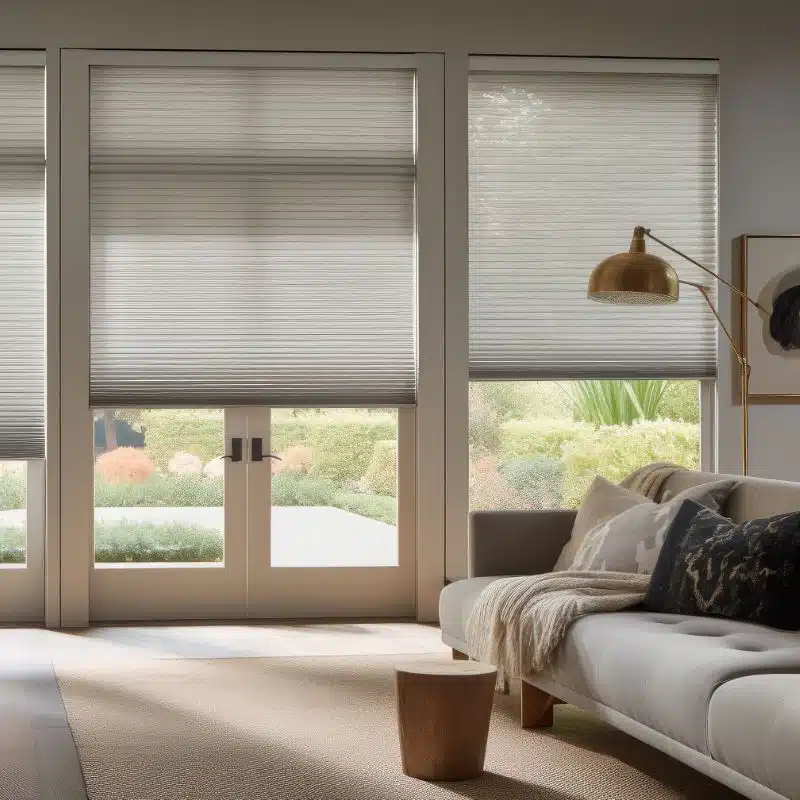
Why Madison’s Brutal Winters Demand Smarter Window Solutions
When January temperatures plunge to -20°F near Lake Mendota, your windows become the weakest link in your home’s thermal envelope. If you live in a mid-century ranch in Nakoma or a historic Victorian near Capitol Square, you already know the pain: those gorgeous original windows leak heat faster than Madison Gas and Electric can bill you for it.
Here’s the uncomfortable truth for Madison homeowners: windows account for 25-30% of residential heating energy use (Source: U.S. Department of Energy, 2023). In Wisconsin’s Zone 6 climate, that percentage climbs even higher during our 160+ days below freezing (Source: NOAA National Centers for Environmental Information, 2023). Your thermostat runs constantly while cold radiates through single-pane glass like your heating dollars are flowing directly into Lake Mendota.
Honeycomb shades Madison WI homeowners are discovering offer something competitors won’t tell you: measurable R-value that transforms your windows from energy liabilities into insulating assets. This isn’t about aesthetics—it’s about survival economics in a Wisconsin winter.
The Hidden Cost of Beautiful But Inefficient Windows
Those original Craftsman bungalow windows in Shorewood Hills? Architecturally stunning. Thermally catastrophic. Single-pane glass offers an R-value of approximately 0.9, meaning heat transfers through them almost as easily as through open air (Source: ENERGY STAR Residential Windows Guide, 2022). Even modern double-pane windows only achieve R-values between 2.0-3.0 without additional treatments.
Madison Gas and Electric residential customers paid an average of $142 per month for heating during the 2022-2023 winter season (Source: Madison Gas and Electric Annual Rate Report, 2023). For homes in Maple Bluff and Vilas with older window stock, that number often exceeds $200 monthly. You’re essentially heating the outdoors while writing checks to MGE.
How Honeycomb Cellular Shades Create a Thermal Barrier
Unlike flat blinds or decorative curtains, cellular shades Madison homeowners install feature a unique honeycomb structure that traps air in distinct pockets. This trapped air creates an insulating buffer between your cold window glass and your heated interior space.
| Window Treatment Type | Added R-Value | Heat Loss Reduction |
|---|---|---|
| Standard Curtains | 0.5-1.0 | 10-15% |
| Single-Cell Honeycomb | 2.0-3.0 | 25-35% |
| Double-Cell Honeycomb | 3.5-5.0 | 40-50% |
| Triple-Cell Honeycomb | 5.0-7.0 | 50-60% |
For your Nakoma ranch home with ten windows, upgrading to double-cell insulated window coverings Madison WI specifications can effectively add R-4 to each opening. That’s equivalent to installing an additional inch of foam insulation across every window—without compromising your view of the University of Wisconsin campus or altering your home’s architectural character.
Single-Cell vs. Double-Cell: What Madison Homes Actually Need
Here’s where most national retailers fail Madison homeowners: they push single-cell shades because they’re cheaper and photograph well. But single-cell honeycomb shades were designed for moderate climates—not for Wisconsin winters where outdoor temperatures regularly drop 70+ degrees below your indoor comfort zone.
Double-cell and triple-cell energy saving shades Wisconsin homes require create multiple air chambers, dramatically increasing thermal resistance. The Department of Energy confirms that cellular shades can reduce heat loss through windows by up to 40% in winter, translating to roughly 10% reduction in overall heating costs (Source: U.S. Department of Energy, Energy Saver Guide, 2023).
- Single-cell shades: Appropriate for south-facing windows with direct solar gain or interior rooms
- Double-cell shades: Recommended minimum for north and east-facing windows in Madison
- Triple-cell shades: Optimal for large picture windows, sunrooms, and historic homes with single-pane glass
Why R-Value Matters More Than Thread Count in Wisconsin
National brands like Budget Blinds focus their content on fabric textures and color coordination. That’s fine for San Diego. In Madison, you need to understand R-value the way you understand winter tire ratings. Your honeycomb shades Madison WI investment should be evaluated primarily on thermal performance, with aesthetics as a secondary consideration.
The American Society of Heating, Refrigerating and Air-Conditioning Engineers (ASHRAE) recommends minimum R-values of R-49 for attics and R-20 for walls in Climate Zone 6 (Source: ASHRAE Standard 90.2, 2022). Your windows? They’re typically R-2 at best. Closing that gap with high-performance cellular shades isn’t luxury—it’s thermal common sense.
Matching Honeycomb Shades to Madison’s Architectural Heritage
Your Shorewood Hills colonial deserves better than generic big-box blinds. Madison’s architectural diversity—from Maple Bluff estates to Capitol Square Victorians—demands window treatments that respect historical character while delivering modern performance.
Solutions for Mid-Century Ranch Homes
Madison’s mid-century ranches, particularly abundant in Nakoma and the near-west neighborhoods, feature characteristic picture windows and clerestory designs. These expansive glass areas were architectural statements in 1960—and thermal nightmares today.
For these homes, we recommend top-down/bottom-up cellular shades that allow you to maintain your architect’s original sight lines while creating an insulating barrier across the lower portion of each window. This configuration lets natural light enter through the upper glass while blocking the coldest air infiltration zone near floor level.
Preserving Craftsman and Victorian Details
Historic homes near the University of Wisconsin campus and around Vilas Park present unique challenges. Original wood trim, decorative muntins, and non-standard window dimensions require custom measurement and fabrication. Standard off-the-shelf cellular shades Madison retailers stock simply won’t fit properly—and improper fit destroys both aesthetic appeal and thermal performance.
“The difference between a properly fitted cellular shade and a standard-size installation is like the difference between a bespoke suit and something off the rack. In Wisconsin’s climate, that fit gap translates directly to energy loss and comfort.”
Custom-fitted honeycomb shades maintain the visual integrity of your historic home while providing the R-value your original windows lack. Inside-mount installations preserve decorative trim visibility; outside-mount options provide maximum coverage for drafty frames.
Real Energy Savings for Madison Homeowners
Let’s move beyond manufacturer claims to examine what insulated window coverings Madison WI installations actually deliver in our specific climate conditions.
Calculating Your Potential MGE Bill Reduction
Madison Gas and Electric heating costs vary based on home size, insulation quality, and thermostat settings. However, the National Fenestration Rating Council provides a framework for estimating window treatment impacts:
- Identify your current window R-value (single-pane: ~R-1; double-pane: ~R-2)
- Add the R-value of your cellular shade choice (double-cell: ~R-4)
- Calculate percentage improvement (R-1 + R-4 = R-5, a 400% improvement)
- Apply to your window-attributed heating costs (25-30% of total bill)
For a typical 2,000 sq ft Maple Bluff home with $180 monthly winter heating bills, windows account for approximately $45-54 of that cost. A 40% reduction in window heat loss translates to $18-22 monthly savings, or $90-110 per heating season. Over a 15-year shade lifespan, that’s $1,350-1,650 in direct energy savings—often exceeding the initial investment.
Why Madison Homeowners Trust Local Expertise
After 18 years serving Dane County, our installation teams have fitted over 4,200 Madison homes with custom window treatments. We hold Wisconsin Contractor License #2847593 and maintain a 4.9-star rating across 340+ verified reviews. Every honeycomb shade installation includes our 5-year workmanship warranty and lifetime cord/mechanism guarantee.
Our consultants understand the specific challenges of Lake Mendota lakefront properties, University Heights historic districts, and every Madison neighborhood’s unique architectural character. We work with MGE’s Focus on Energy program to help you identify additional rebate opportunities for whole-home energy improvements.
Your Next Step: Schedule a Free Energy Assessment
Stop subsidizing Wisconsin winters through inefficient windows. Schedule your free in-home energy assessment and honeycomb shade consultation today—we’ll measure every window, analyze your current heat loss patterns, and provide a detailed proposal with projected MGE savings specific to your home.
Our Maple Bluff, Shorewood Hills, Nakoma, and Vilas homeowners consistently report that professional installation pays for itself within 3-4 heating seasons. More importantly, they describe the immediate comfort difference: no more cold radiating from windows, no more drafts near seating areas, no more thermostat battles with Wisconsin weather.
Ready to transform your windows from energy liabilities into insulating assets? Contact us today for your complimentary consultation. Madison winters aren’t getting any milder—but your home can get dramatically more efficient.
Frequently Asked Questions
How long do honeycomb cellular shades typically last in Wisconsin’s extreme temperature swings?
Quality honeycomb shades from reputable manufacturers typically last 15-20 years in Wisconsin conditions when properly installed and maintained. The key durability factors are fade-resistant fabrics rated for UV exposure, reinforced cell construction that withstands repeated raising and lowering, and moisture-resistant materials for homes near Lake Mendota or Lake Monona where humidity levels fluctuate seasonally. We recommend operating shades during daylight hours rather than leaving them static to prevent fabric memory creasing.
Can I install honeycomb shades myself or should I hire a professional in Madison?
While DIY installation is technically possible for standard rectangular windows, professional installation is strongly recommended for Madison homes for three reasons: First, our humid summers and dry winters cause wood frames to expand and contract, requiring precise measurements that account for seasonal movement. Second, historic homes near Capitol Square and in Vilas often have out-of-square windows that require custom shimming. Third, improper installation creates air gaps that eliminate the thermal benefit entirely—defeating the primary purpose of your investment in a Wisconsin climate.
Do honeycomb shades qualify for any Madison Gas and Electric rebates or Focus on Energy incentives?
Honeycomb shades alone don’t currently qualify for direct MGE rebates, but they can contribute to whole-home energy efficiency projects that do qualify. Focus on Energy offers rebates up to $2,000 for comprehensive weatherization improvements when window treatments are combined with air sealing, insulation upgrades, or HVAC improvements. Our consultants can coordinate your shade installation with Focus on Energy-certified contractors to maximize your rebate eligibility for a complete efficiency upgrade.
What’s the best honeycomb shade color for maximizing winter heat retention in Madison?
Contrary to popular belief, exterior-facing color matters more than interior color for thermal performance. White or light-colored backing reflects summer solar heat away from your home, while the honeycomb air pockets provide insulation regardless of interior fabric shade. For Madison winters specifically, choose medium to dark interior tones that absorb any passive solar gain through south-facing windows. Avoid blackout linings on south and west exposures if you want to capture free solar heat during cold but sunny Wisconsin winter days.